
 Kasese Guide Radio
Kasese Guide Radio
Kasese Guide Radio
31 March 2026, 12:04 pm
By Yoweri Kaguta
Kasese: The 2026 climate outlook predicts a continuation of high global temperatures, likely making it one of the hottest years on record.
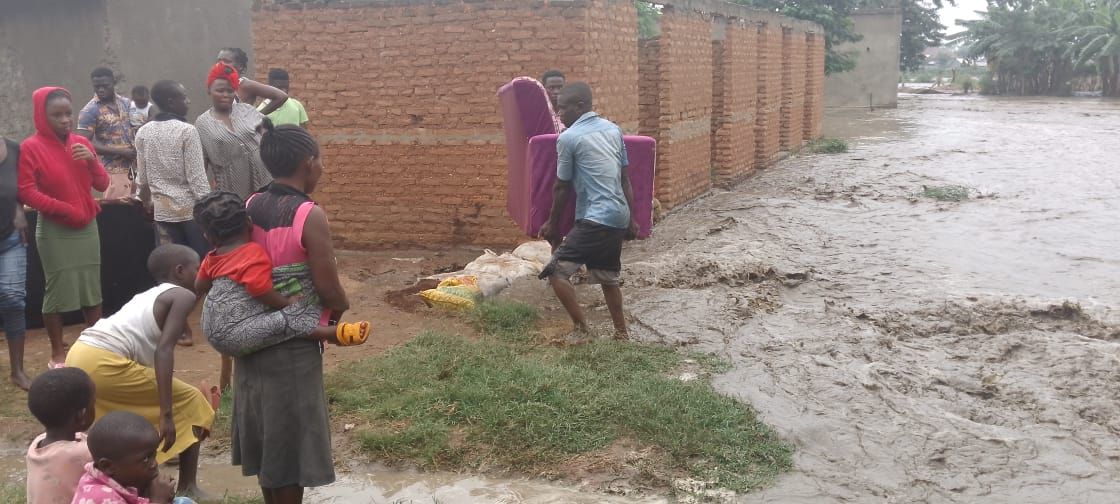
Kasese District, which comprises 44 lower local governments, is experiencing showers in several areas. Locals, particularly those living at higher altitudes, have been urged to remain on high alert as water levels in rivers flowing from the Rwenzori Mountains continue to rise sharply, raising fears of possible flooding.
Mid-March this year saw rising water levels in rivers including Nyamwamba River, Nyamughasana River, Mubuku River, Sebwe River, and Thako River. In some areas, the fast-rising waters are already eroding riverbanks and threatening nearby homes.
Emmanuel Katuramu, a community leader, confirmed to this reporter that residents in Kyondo, Majengo, and parts of Kihara in Nyamwamba Division of Kasese Municipality are living in fear of a repeat of floods.
“Rain started affecting this area last week. My family and the entire village of more than 2,500 people are living in total fear,” he said.
Kasese has experienced unprecedented weather conditions over the past 13 years, according to several seasonal climate and weather outlooks for Uganda. Locals have become accustomed to the pattern that at least every May, floods and landslides occur, often destroying infrastructure such as schools, bridges, crop gardens, and roads, all at significant cost.
Uganda experiences two major rainfall seasons: March–April–May (MAM) and September–October–November–December (SOND), the first and second rainy seasons, respectively.
The MAM 2026 rainfall forecast indicates that most parts of the country are expected to receive near-average rainfall. Kasese, located in the western region, falls under the Southern region. The onset of the seasonal rainfall has already been recorded, with peak rainfall expected between early and late April, and cessation anticipated towards late May. The region is expected to receive near-normal rainfall, with an increased likelihood of above-normal precipitation during this season.
In Kanyangeya Village, a house collapsed during a heavy downpour, leaving a seven-year-old boy with minor leg injuries. A similar incident occurred in Kaghema Village, Kyarumba Sub-county, Bukonzo County East, where a permanent house belonging to Naume Nyakagumba was destroyed during heavy rains on Wednesday, 25 March 2026.
Mustafa Kikusa, Chairperson of the Kasese District Disaster Management Committee, advised residents to stay away from river valleys and other low-lying areas.
“Early warning systems indicate drastic rises in rivers such as Nyamwamba and Mubuku, and we are urging residents living adjacent to riverbanks to evacuate for their own safety,” he said.
Joseph Singoma, Kasese District Senior Planner, explained that the district requires 86 billion shillings to manage the post-disaster recovery plan, an increase from the 65 billion shillings needed to fund recovery after the 2020 disasters that severely affected the district.
On 18 February 2026, the Ministry of Finance, Planning and Economic Development revealed that the Government of Uganda will require at least $28.7 billion (approximately 99 trillion shillings) over the next seven years to effectively mitigate and adapt to climate change.
This information was presented by Dennis Mugagga, Head of the Climate Finance Unit at the Finance Ministry, during the first African Symposium on Natural Capital Accounting and Climate-Sensitive Macroeconomic Modelling. Hosted by Makerere University in Kampala, the symposium aimed to strengthen Africa’s capacity to integrate climate and nature-related risks into macroeconomic and fiscal policy.
Uganda already has a Nationally Determined Contribution framework outlining actions required to reduce greenhouse gas emissions and strengthen resilience. Mr Mugagga explained that climate-related investments are split between mitigation, which focuses on reducing emissions, and adaptation, which helps communities cope with climate shocks such as droughts, floods, and heatwaves.
The government currently invests about $2.1 billion annually across sectors such as energy, water, agriculture, and infrastructure, leaving a substantial annual financing gap of nearly $2 billion.