
 Time FM
Time FM
Time FM
8 October 2026, 8:09 am
By Shadrach Bethel Afayo
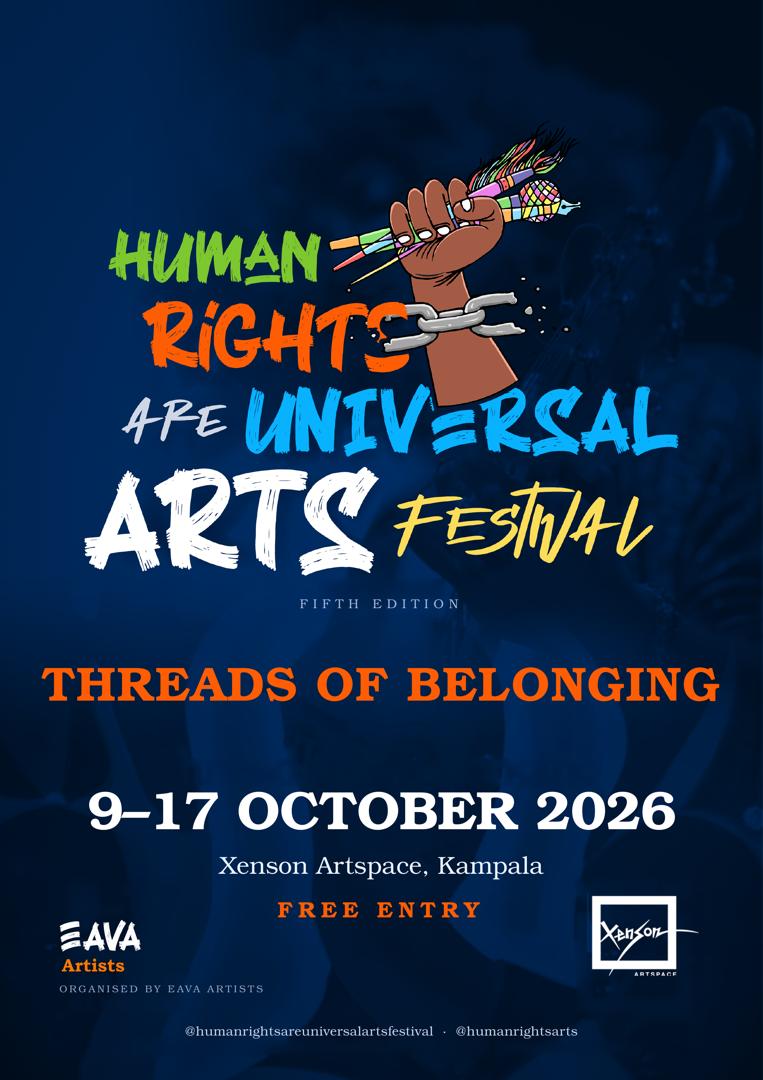
The East African Visual Artists’ Human Rights Are Universal Arts Festival is returning to Kampala with a new theme, a longer programme and a wider invitation to participate.
The fifth edition of the festival will run from October 9 to 17 at Xenson Art Space in Kamwokya under the theme “Threads of Belonging.”
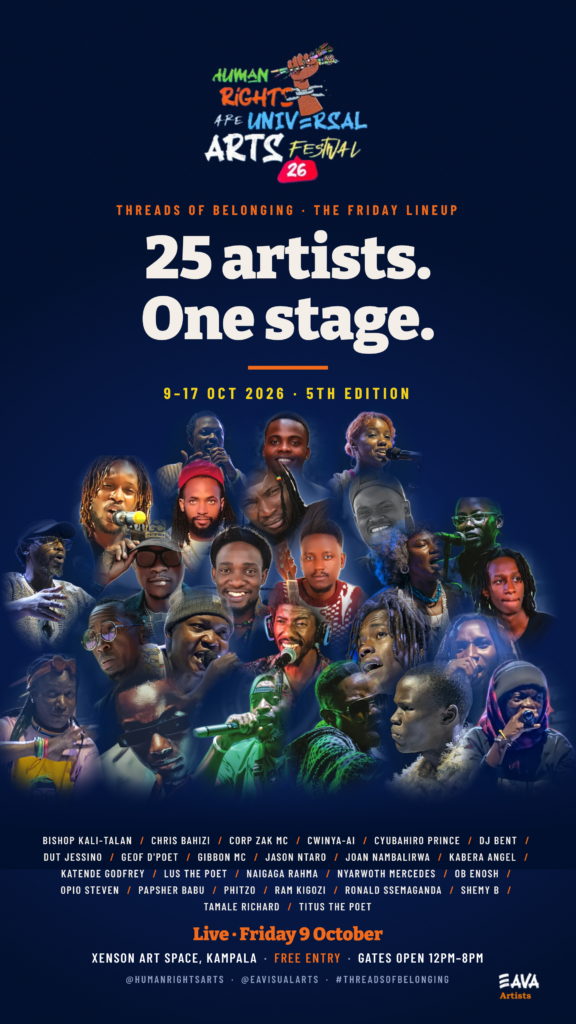
The festival follows last year’s four-day edition, which was held under the theme “Defend” and brought together artists, activists, musicians, poets, vendors and members of the public to explore the relationship between creative expression and human rights. This year’s programme is expected to include visual-art exhibitions, panel discussions, public conversations, music, poetry, performances, networking opportunities and medical camps.
Organised by the East African Visual Artists collective, the festival seeks to create a space where art can be used to examine how people relate to one another, how communities are formed and what happens when individuals or groups are excluded from society. The theme “Threads of Belonging” turns attention to the connections that hold people together through family, culture, identity, shared responsibility and common humanity.
The festival comes at a time when questions about belonging have become increasingly important in Uganda. The country is negotiating debates around political identity, ethnic and cultural belonging, gender, sexuality, migration, digital citizenship, religion and the rights of minorities. These debates often take place in environments where public disagreement can be difficult and where many people fear being misunderstood, labelled or punished for expressing their views.
For the organisers, the festival offers an alternative setting where such conversations can take place through paintings, films, music, poetry and dialogue. It gives people an opportunity to approach sensitive issues through personal experience and creative interpretation rather than through confrontation alone.
Dr Ben Kibirige, who is leading the organising committee, said this year’s festival would be bigger and longer than the previous edition. He said the extended programme would create more room for participation, exhibition and interaction among artists, audiences, human-rights advocates and other members of the public.
“This year’s festival is coming bigger than the previous edition,” Dr Kibirige said. “We are extending it to nine days so that people have more time to engage with the programme, the artists and the conversations. We have a fresh set of panellists and entertainers, and we are also creating more space for people to exhibit their work.”
He said the programme would combine public dialogue with entertainment and practical services. “The festival will bring together panel discussions, performances, exhibitions, music and other forms of entertainment. We will also have medical camps and spaces where people can network, share ideas and build relationships. The aim is to make the festival accessible, useful and engaging to different audiences.”
The longer programme is intended to allow visitors to spend more time with the artworks and to give the various discussions the attention they require. Unlike an event that concentrates all its activities into a few days, the nine-day programme will allow the public to return, follow different conversations and engage with artists whose work addresses social and human-rights concerns.
Last year’s edition demonstrated the potential of this approach. The “Defend” festival used music, poetry, painting, film and panel discussions to explore questions of dignity, freedom, equality and accountability. Performances by Ephraim and Edwardo Kayondo, including their rendition of “Mirembe”, provided an emotional opening to conversations about refugees, victims of war and people displaced by conflict.
The festival also included a six-month artist residency whose participants presented work reflecting themes of identity, justice and resilience. Children took part in painting and dance activities, while the wider programme included vendor stalls, poetry slams, street art, music and free health services.
This year, the organisers are building on that experience while changing the way some of the conversations will be conducted. Vincent Kyabayinze, the Executive Director of East African Visual Artists, said the festival would create more intimate spaces where audiences and panellists could interact more freely.
“We are looking at a different approach to the conversations this year,” Kyabayinze said. “We want to create spaces that are more intimate and less formal, where the audience can feel closer to the panellists and participate more actively. It should not be a situation where one person speaks on a stage and everyone else simply listens. We want people to ask questions, share their experiences and engage with the issues being discussed.”
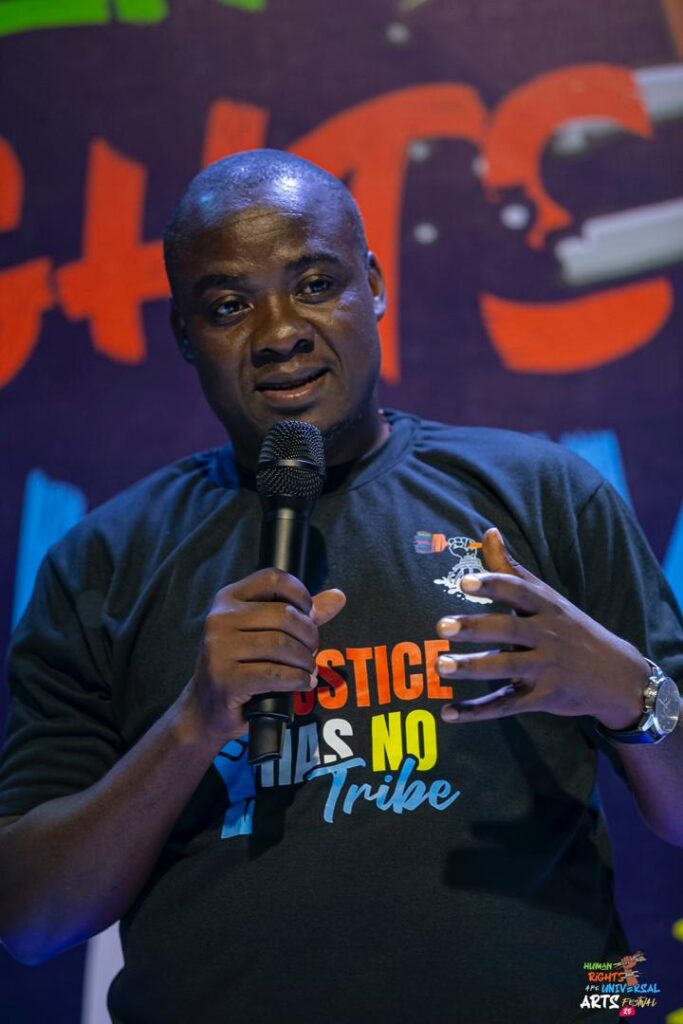
He said a smaller and more participatory format would allow the festival to move beyond speeches and presentations. “When the space is more intimate, people are able to listen to one another better. They can ask questions that may not come up in a large hall, and panellists can respond to the realities that people are living through. That interaction is important because human-rights conversations should not be separated from people’s everyday experiences.”
Kyabayinze also said this year’s festival would place young people at the centre of both the programme and the future of the initiative. “Young people dominate this space, and we have to recognise that they are not only the audience but also the people shaping the conversations,” he said. “This festival has to begin preparing for a long-term transition in which the young people take ownership of it and carry it forward.”
He said the involvement of young people should not be limited to performances or exhibition opportunities. “We want young people to be part of the thinking, planning and direction of the festival. If the festival is going to have a long-term presence, its future must gradually shift into the hands of the young people who are already creating, organising and using art to speak about the issues affecting them.”
That focus on young people is significant in a country where a large part of the population is young and where digital platforms have changed how citizens communicate, organise and express their identities. Young Ugandans are using music, short films, photography, visual art, spoken word and social media to discuss unemployment, mental health, gender, climate change, inequality, police conduct, political participation and social exclusion.
At the same time, the digital space presents new challenges. Online harassment, surveillance, misinformation, abuse and privacy violations can discourage people from speaking openly. The festival’s conversations are expected to include questions about digital rights, data protection, online security and the ways technology is influencing identity and participation.
The event’s programme will also include an information exhibition, a health camp and a digital hub. The health camp will provide an opportunity for visitors to access medical information and services while engaging with the festival. Bringing health services into a human-rights arts space reflects the idea that the right to health is connected to dignity, inclusion and access to basic services.
The inclusion of medical activities is also practical. Many people may attend the festival for entertainment or exhibitions but find an opportunity to receive health information, testing, counselling or other services. Such initiatives can reduce the distance between public dialogue and the everyday needs of communities.
The festival’s emphasis on belonging is taking place against a difficult human-rights background in Uganda. The 1995 Constitution protects freedom of speech and expression, peaceful assembly, association, equality and other fundamental rights. Article 29, for example, provides for freedom of expression, peaceful assembly and association.wipo+1
However, the existence of rights in law does not always guarantee that people can exercise them without fear. The 2024 United States Department of State human-rights report documented significant concerns, including restrictions on freedom of expression and media freedom, violence and intimidation against journalists, arbitrary arrests, unlawful detention, torture allegations and pressure on civil-society groups.
In July 2026, the UN Human Rights Office also warned that Uganda was experiencing a growing climate of fear, with opposition supporters, journalists, human-rights defenders and civil-society organisations facing heightened risks. The UN reported that at least 50 opposition leaders and supporters, five human-rights defenders and five journalists had reportedly been subjected to abuses in the months following the January general election.
The UN High Commissioner for Human Rights, Volker Türk, said the actions of the authorities were “creating a climate of fear that is increasing self-censorship, further stifling public debate and deepening polarization.”
These concerns explain why independent spaces for discussion remain important. When people are afraid to speak in political, institutional or public settings, art can provide another way to communicate experiences that might otherwise remain hidden. A painting can express grief, exclusion or anger without presenting a formal political statement. A poem can raise questions about injustice. A film can make audiences see the life of someone who is often reduced to a stereotype.
Kyabayinze said EAVA’s work is based on the belief that art should create room for people to examine the complexity of human lives. He referred to the organisation’s documentaries, including “Life on the Street” and “A Silent Disease”, as examples of work that looks beyond public labels.
“People are often more complex than the labels society places on them,” he said. “When we tell these stories, we want audiences to see the person behind the label, the mother, the daughter, the breadwinner, the student or the neighbour. That is part of what belonging means. It means recognising people in their full humanity.”
He added that art should not be reduced to a simple political slogan. “Art should never, at any point, be a poster,” Kyabayinze said. “It should give people the opportunity to think, interpret and ask questions. It can open a conversation without forcing everyone to arrive at the same conclusion.”
That approach is important in a polarised society. Human-rights discussions can easily become confrontational when people feel that they are being accused or forced to adopt a particular position. Art can create a pause between an issue and the audience’s response. It can invite reflection and empathy, allowing people to encounter difficult subjects through emotion, memory and lived experience.
The theme “Threads of Belonging” also creates space to examine who is included and who is excluded. Belonging can be shaped by nationality, tribe, religion, gender, disability, occupation, age, sexuality, social class or political identity. People may be accepted in one space and marginalised in another. The festival’s programme is expected to explore how these identities overlap and how social structures can either strengthen or weaken people’s sense of dignity and participation.
A festival of this kind cannot resolve Uganda’s human-rights challenges by itself. It cannot replace legal reform, independent investigations, accountable institutions or protection for journalists and human-rights defenders. It can, however, strengthen public awareness and provide a meeting point for people who may otherwise remain separated from one another.
Its value also lies in creating connections among artists, civil-society organisations, health practitioners, cultural leaders, students, entrepreneurs and members of the public. Networking is not simply an additional activity; it can help people find collaborators, share resources, identify support and develop future projects.
The festival also supports young artists by creating opportunities to exhibit their work and interact with audiences. For emerging artists, access to a gallery, mentorship, public discussion and professional networks can help them develop sustainable careers. The planned expansion of exhibition space means that more artists will have an opportunity to present their work and contribute to the festival’s wider conversation.
Dr Kibirige said the expanded programme was designed to make the festival more inclusive. “We want more people to find a place within this year’s edition,” he said. “That means creating more room for artists to exhibit, audiences to participate, panellists to engage and visitors to access services. The festival should not belong only to the organisers or the established names. It should belong to everyone who comes with something to share or learn.”
As Uganda marks another Independence Day, the festival raises questions about the meaning of freedom beyond political sovereignty. Independence is not only about the existence of a national flag, government institutions or territorial borders. It is also about whether people can live with dignity, speak without fear, associate peacefully, access healthcare, participate in public affairs and feel that they belong to the society in which they live.
The arts can help make those questions visible. They can preserve memories that institutions overlook, amplify voices that are not usually heard and encourage citizens to imagine a more inclusive future. They can also remind audiences that human rights are not abstract ideas reserved for courts, conferences or official documents. They affect families, workers, students, artists, refugees, patients, journalists and communities.
The return of the Human Rights Are Universal Arts Festival under the theme “Threads of Belonging” is therefore timely. It comes at a moment when public debate is under pressure, when digital spaces are both expanding and restricting participation, and when many citizens are questioning where they fit within the country’s political and social life.
At Xenson Art Space from October 9 to 17, the festival will bring together art, activism, health, entertainment and public dialogue. Its most important contribution may be the space it creates for people to meet across their differences and listen to one another.
For EAVA, the future of the festival rests increasingly with young people. For its audiences, the event offers an opportunity to engage with art while reflecting on the responsibilities that come with belonging. And for Uganda’s human-rights conversation, it offers a reminder that protecting dignity requires more than laws. It requires public participation, empathy, accountability and the courage to keep creating spaces where people can speak, listen and be seen.