
 Voice of Lango
Voice of Lango
Voice of Lango
29 January 2026, 3:00 pm
By Joshua Olomo
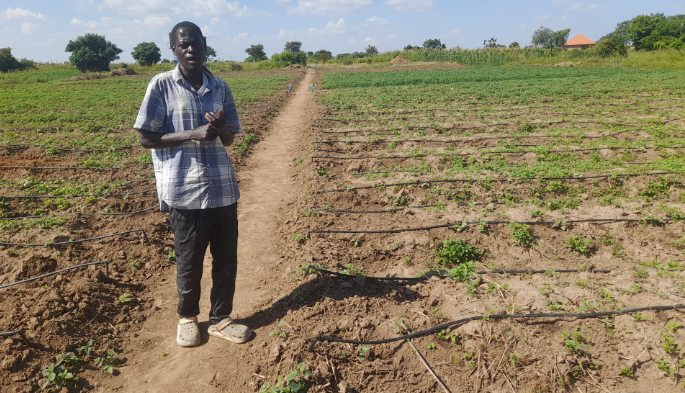
The Uganda Intergovernmental Fiscal Transfer (UgIFT) Micro-Scale Irrigation Project has strengthened the climate resilience and livelihoods of 43 farmers in Kwania District.
The project supports farmers in establishing irrigation infrastructure that enables year-round cultivation, helping to mitigate the effects of droughts and erratic rainfall on crop production.
Under the programme, farmers contribute 25 percent of the cost for solar-powered irrigation systems, while the government covers the remaining 75 percent. For diesel-powered systems, farmers pay 75 percent, with the government contributing 25 percent.
According to Tadeo Mibulo, the Kwania District Senior Agricultural Engineer, 43 irrigation systems have been installed across the district since the project began in the 2022/23 financial year.
Betty Akello, a farmer from Alido Parish in Chawente Subcounty, uses water from Lake Kwania to irrigate her four-acre garden of tomatoes and watermelons.
With support from the district agricultural department, she received two micro-scale irrigation units and says that irrigation farming has significantly improved both her yields and household income.
Akello reports earning over UGX 20 million per season from the sale of watermelons and tomatoes grown in her garden.
She uses the income to pay her children’s university tuition and to fund the construction of a house.
George Okwany, a resident of Akwaiwanga in Atongtidi Sub county, noted that the high cost of irrigation equipment limits wider adoption, constraining the expansion of climate-resilient agriculture.
Moses Okech, from Abali in Atongtidi Sub county, urged the government to expand access to irrigation by establishing community-based schemes at parish or subcounty level, promoting equitable resource management rather than relying on individual ownership of systems.
Jimmy Okweny, the District Senior Environment Officer, urged communities around Lake Kwania to practise irrigation farming outside the lake’s buffer zones, protecting the water body from agrochemical runoff and ecosystem degradation.
Meanwhile, Betty Acio Akejo, the Senior Agricultural Officer, emphasised sustainable irrigation practices, highlighting their role in climate adaptation, environmental conservation, and poverty reduction in the district.
This story was supported by ACME (Africa Centre for Media Excellence) in partnership with Climate Smart Jobs Uganda (CSJ.