
 Ssebo FM
Ssebo FM
Ssebo FM
24 August 2026, 9:29 am
By Ali Lukomo
Daudi Migereko, the former Minister of Lands and current chairman of the Uganda Railways (URC) Board, has called on Resident District Commissioners (RDCs) and local leaders to urgently mainstream President Yoweri Museveni’s four-acre model as a key strategy to combat poverty, reverse low agricultural productivity, and shift smallholder farmers away from unprofitable sugarcane cultivation toward intensive, high-value farming.
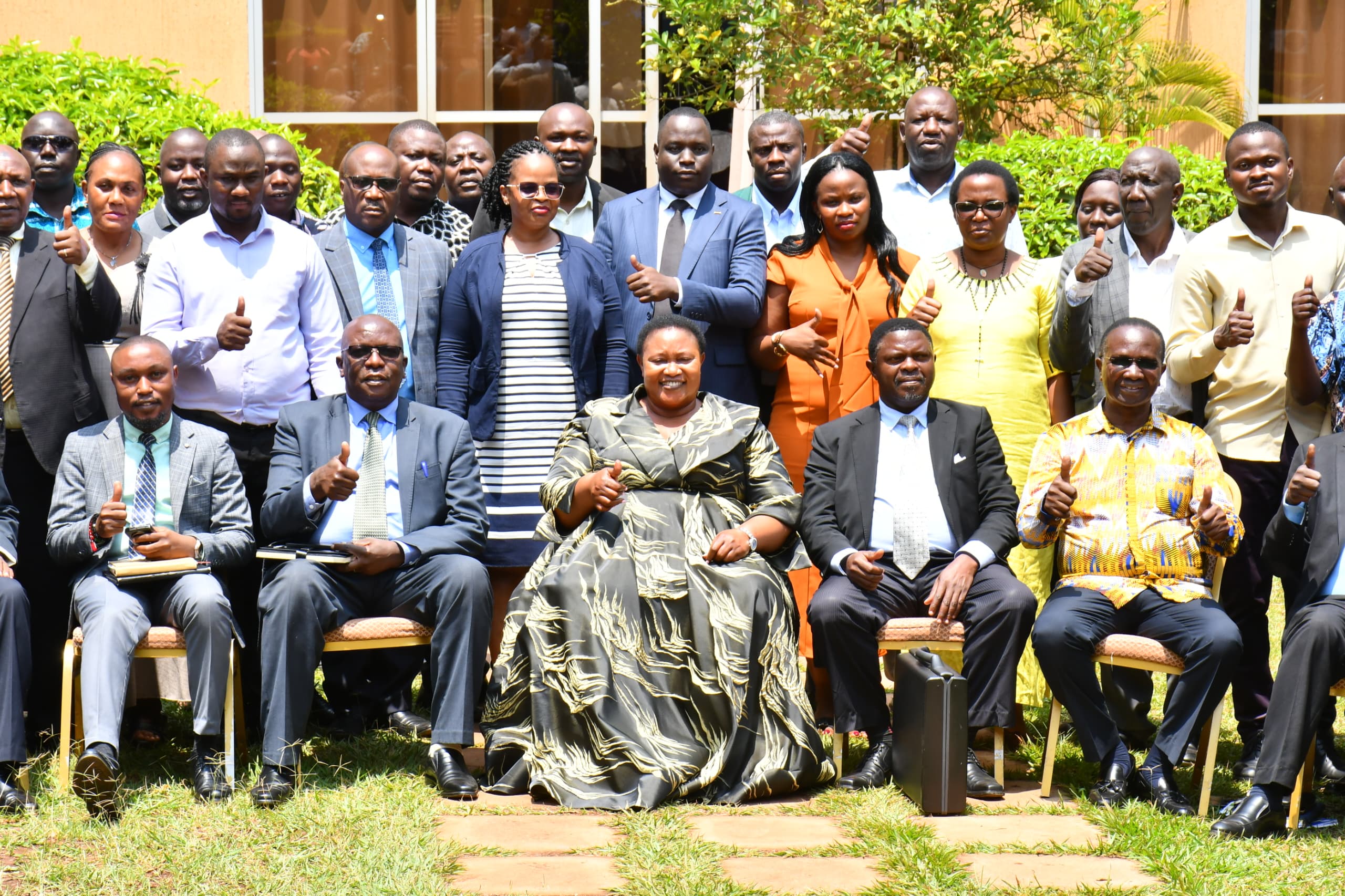
Speaking at the closure of the three-days meeting with RDCs at Source of the Nile Hotel in Jinja City, Migereko stressed that the model—championed by President Museveni during regional tours—is particularly relevant for households with less than four or five acres.
“Those who are having less than four acres, five acres, the President’s message has been very clear. Please leave the sugarcane business for farming and focus on the four-acre model,” he said.
He said that the President has used success story examples like Basangwa in Kamuli, Kazibwe in Busesde Jinja Nyakana in Kabarole and Ijara in serere and demonstrated that with very small land holdings, one can make huge profits and become a billionaire adding that this is a message the RDCs must deliver everywhere.
“We should try to replicate this success in every parish in Busoga subregion,” Migereko advised adding that with such demonstrations one can become a billionaire.
He highlighted a stark productivity gap in sugarcane: large estates such as those run by Madhvani and Mehta achieve over 120 tones per acre, while ordinary smallholder farmers typically harvest only 20 to 40 tones and often operate at a loss. Market gluts further compound the problem, leaving many farmers busy yet unprofitable. “There is no productivity on their farms,” Migereko noted, recalling earlier meetings on the sugar law that exposed these realities.
The four-acre model, he explained, promotes intensive rather than extensive agriculture in response to rapid population growth and severe land fragmentation. In areas such as Kityerera Subcounty in Mayuge District, research has shown that around 70 percent of households have access to less than one acre, much of it previously locked into long-term sugarcane leases.
“When we talk about the four-acre model, the President is actually talking about intensive agriculture which includes zero grazing, poultry, coffee and piggery,” Migereko said.
High-value crops suitable for small plots—onions, garlic, tomatoes, spinach, cabbages, sukuma wiki, passion fruit and others—can generate far higher returns than staple crops like maize or sugarcane on limited land.
Migereko cited a spinach farmer in the region who, on less than one acre and with irrigation support, transformed his livelihood and even purchased a pickup truck for market transport.
“Once the enterprise selection is right, even when people appear to be having small land holdings, there is something that they can do that will ensure that they earn reasonable income every week, every month, and the whole year,” he said.
He urged RDCs, as the President’s closest representatives in the districts, to take ownership.
“If the four-acre model is to succeed or not succeed, you are accountable.” Migereko questioned why many districts lack specialised officers or desks dedicated to the model despite its inclusion in the NRM manifesto and the National Development Plan.
He called for district planning committees, working with elected leaders and agricultural officers, to zone areas by suitable enterprises, deploy resources accordingly, and develop clear production plans.
District planning commitees and elected leaders must take interest in the four-acre model, in interest free loans available through banks such as Centenary, Pearl Bank, Equity and Stanbic among others—and must guide the allocation and location of solar powered boreholes to support the four-acre model.
RDCs and elected leaders must take interest in these interest free loans and popularise them. They must move with bank managers to interest people pursuing the four-acre model to acquire credit for production, to take on irrigation.
Irrigation was flagged as critical: many Busoga districts previously returned allocated irrigation funds to the treasury. New solar-powered boreholes, reservoirs and a parliamentary loan for irrigation expansion offer fresh opportunities to support the model, Migereko noted. A forthcoming revolving fund for fertilisers and irrigation was also referenced.
He gave an example of Egypt which earns billion dollars every year out of exporting vegetables and fruits to Europe.
“Countries like Egypt which is in a desert depending on waters of River Nile is able to produce vegetables and fruits and earns billions of dollars every year from this intensive agriculture,” Migereko highlighted.
Drawing on a Ministry of Agriculture and State House document on computations (ekibalo) profitability analysis and strategic interventions per value chain, he advised that enterprise selection tools be shared down to parish level. Local leaders must lead by example, he added, rather than remaining dependent on market-bought food while advocating the model to others.
Depend on Irish potatoes, vegetables, tomatoes and rice imported from neighbouring countries must be stopped. This clearly demonstrates that there is ready market in Busoga.
“When you go to Ambercourt market along the Jinja-Budondo road in Jinja City or to Iganga town, you find trucks from Kenya delivering Irish potatoes, tomatoes, vegetables like sukumawiki and Rice from Tanzania, this clearly shows that there is ready market for produce under the four-acre model.
Migereko warned that a new government appraisal system will evaluate officials on tangible production outcomes—acres opened, quantities produced and utilisation of resources—with scores below 75 percent risking termination of services. “This is not a simple matter; it is not a joking matter. Even your jobs are at stake.”
He closed with an appeal for collective action: “Let us go back, sit down with our district planning committees and elected leaders, and we come up with clear plans for production and wealth generation in our areas of jurisdiction.”
The timing, he insisted, is now—immediately after elections—to turn the four-acre model into a practical antidote to poverty and food insecurity in the Busoga sub region and country as a whole.