
 Tembo FM
Tembo FM
Tembo FM
4 September 2026, 6:39 pm
By Isaac Olweny
Omiya Pacwa Subcounty | Agago District: Leaders and residents in Agago District are calling for urgent intervention to address escalating human-wildlife conflict, as elephants and buffaloes continue to invade communities, destroying crops and threatening the lives and livelihoods of residents.
The Chairperson of Omiya Pacwa Subcounty, Hon Obita Quinto Okot, criticised the Government for what he described as prioritising wildlife protection at the expense of communities living alongside wild animals.
Quinto said residents of Agago had consistently supported the Government, including by voting overwhelmingly in elections and openly identifying with the ruling NRM, yet were increasingly bearing the cost of wildlife invasions.
He claimed that more than 100 elephants had recently entered the subcounty, destroying crops in two villages.
“A woman collapsed upon seeing the destruction,” Quinto said, describing the impact of the invasion on affected households.
According to the LC3 Chairperson, residents had been informed that Omiya Pacwa lies within an established animal corridor. However, he argued that this should not prevent the Government from protecting communities from wildlife attacks.
He called for electric fencing to be strategically installed around identified hotspots rather than creating a boundary that would unnecessarily restrict the movement of people or wildlife.
Quinto said the main animals involved in the conflict were elephants and buffaloes.
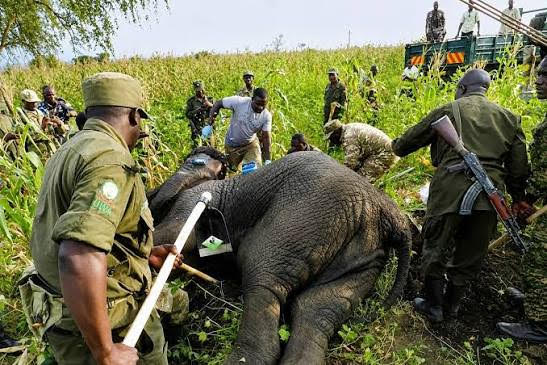
Dr Eric Enyel Morris, who is in charge of Kidepo Valley National Park, said the Uganda Wildlife Authority (UWA) had deployed more than 17 tracking collars on elephants to monitor their movements.
However, he said determining the exact number of elephants in a particular location remained difficult.
Dr Morris explained that when UWA responded to a tracked elephant, officers often found a much larger herd, sometimes consisting of about 30 elephants, including calves.
He said elephants were highly intelligent animals that tended to follow established migratory routes passed down over generations.
According to Dr Morris, the increasing human-wildlife conflict is partly linked to population growth, changing land use and increased human settlement in areas previously occupied by wildlife.
He said similar challenges were being experienced in other protected areas, including Queen Elizabeth National Park, where he had been transferred about five months earlier.
Dr Morris said UWA had tested several methods to control elephant movements, including trenches, chilli blocks, bee-based deterrents, drumming, vuvuzelas and, more recently, scare shooting in Kidepo.
However, he noted that elephants could quickly adapt to repeated deterrents.
Dr Morris said electric fencing had proved effective in reducing human-wildlife conflict in several locations and was among the interventions the Government was considering.
He stressed that the proposed fence was not intended to create a permanent boundary between communities and wildlife, but rather to protect people, crops and animals.
He said the arrangement would also involve a memorandum of understanding between UWA and communities, allowing the fence to pass through private land where landowners consented.
According to Dr Morris, UWA had identified six major hotspots where the intervention was being prioritised.
He said the implementation process had started in Karenga, with the authority awaiting additional materials. He expressed optimism that communities could begin seeing significant relief within five months once the works were completed.
However, he cautioned that some stray elephants could still enter communities, although such incidents would be easier to manage.
Dr Morris said UWA had previously held a community baraza involving Members of Parliament, during which stakeholders agreed that boundaries should first be confirmed before the electric fence was installed.
He said the focus should now shift from debating boundaries to determining when the fence would be installed and completed.
He claimed that some Kitgum District officials were insisting on boundary verification before the fencing could proceed, a position he said was contrary to the proposed intervention map.
“The issue now should be when we are installing and completing the fence, not first the boundary,” Dr Morris said.
Dr Morris also disclosed that UWA had registered 1,025 compensation claims arising from wildlife-related damage.
He said the claims had been forwarded for consideration, with some files already returned and affected residents signing consent forms to facilitate compensation.
Dr Morris apologised to communities for the lack of real-time intervention whenever wildlife entered settlements. He attributed the delays partly to limited manpower, transport and communication challenges, as well as what he described as personal attitudes among some staff.
He said UWA was also conducting research into wildlife migration patterns to better understand what attracts animals to particular areas and explore ways of promoting peaceful coexistence.
The Kidepo Valley National Park official said traditional buffer zones between protected areas and communities had increasingly disappeared as human settlement expanded.
He added that UWA was exploring interventions that would allow communities and wildlife to coexist while reducing crop destruction and threats to human life.
Dr Morris further disclosed that he had presented his proposal for protecting communities to the Paramount Chief of Ker Acholi, Rwot David Onen Acana, who, according to him, endorsed the proposal and called for urgent intervention to address the suffering of affected communities.
With farmers facing repeated crop losses and communities living under constant threat of wildlife incursions, local leaders say the priority should now be to turn the proposed electric-fencing plan into a concrete intervention on the ground.
The big question: When will the electric fence finally be installed?