
 Tembo FM
30 October 2026, 11:16 pm
By Isaac Olweny
Gulu City, Uganda — The Minister of State for Northern Uganda and Woman Member of Parliament for Agago District, Beatrice Akello Akori, has called on farmers across the Acholi sub-region to embrace commercial coffee growing, describing the crop as a major opportunity to increase household incomes, combat poverty and build generational wealth.
The Minister made the remarks on Friday while chairing and officially launching a coffee-growing training programme for farmers in Acholi West at the Office of the Prime Minister (OPM) in Gulu City.
The training brought together farmers from Gulu, Omoro, Nwoya, Amuru and neighbouring districts, alongside technical teams from the Office of the Prime Minister, the Ministry of Agriculture, Animal Industry and Fisheries (MAAIF), Operation Wealth Creation, Roco Paco and other stakeholders.
Addressing participants, Akori described coffee as a potential economic game changer for Acholi, urging communities to take advantage of the region’s fertile soils and agricultural potential to establish sustainable commercial farming enterprises.
She noted that coffee offers farmers a long-term source of income, with well-maintained coffee plantations capable of remaining productive for approximately 35 to 50 years.
According to the Minister, widespread adoption of coffee growing, coupled with proper farming practices and commitment, could significantly reduce household poverty in Acholi within the next five years.
“Coffee is an opportunity for economic transformation, and Acholi must rise to become one of Uganda’s leading coffee-producing regions,” she emphasised.
Akori assured farmers that the Government would continue providing free coffee seedlings to communities across Acholi and Northern Uganda as part of efforts to expand agricultural production and improve household livelihoods.
She also encouraged beneficiaries of government programmes, including the Northern Uganda Social Action Fund (NUSAF IV), the Parish Development Model (PDM) and the Restocking Programme, to invest strategically in coffee production and livestock farming rather than relying solely on short-term consumption.
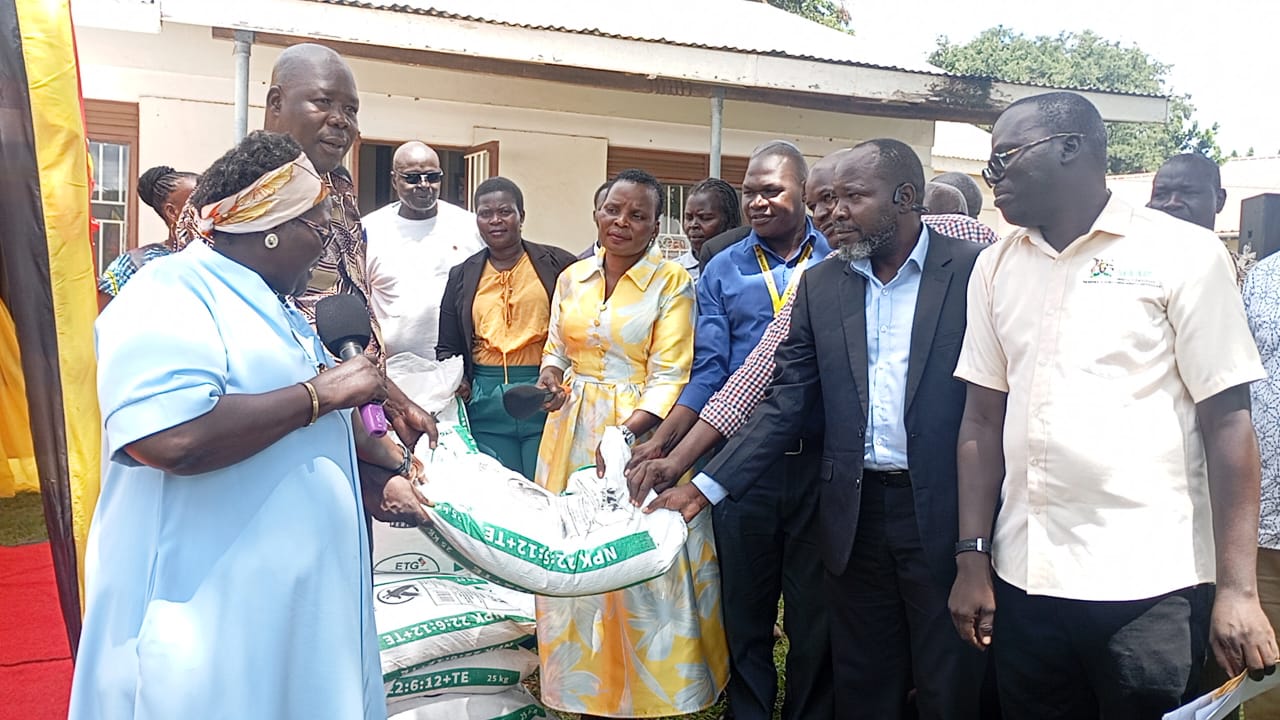
As part of the intervention, the Minister oversaw the distribution of 5,000 bags of NPK fertiliser through the Office of the Prime Minister to committed coffee farmers.
She warned against the diversion, misuse or illegal sale of the agricultural inputs, directing that anyone found selling fertiliser intended for farmers should face arrest.
The Minister further challenged agricultural extension workers to improve service delivery by ensuring proper farmer registration, regular monitoring and physical follow-up of beneficiaries.
She cautioned against fictitious reporting, warning that extension workers who failed to fulfil their responsibilities risked losing their payments.
Highlighting the financial potential of commercial coffee farming, Akori cited possible earnings of between UGX 10 million and UGX 16 million per acre per harvest, depending on productivity and prevailing market conditions.
She also pointed to indicative coffee prices ranging between UGX 12,000 and UGX 16,000 per kilogramme, encouraging farmers to view coffee as a viable long-term investment.
The Minister urged communities to move beyond subsistence farming and adopt more productive agricultural practices that could generate reliable incomes, create employment and improve household welfare.
She credited President Yoweri Kaguta Museveni’s Government for its continued interventions in Northern Uganda, saying farmers should take advantage of available government programmes and agricultural support to improve their economic circumstances.
Akori’s message comes amid renewed efforts to promote commercial agriculture as a pathway to household wealth creation and rural economic development in Northern Uganda.
With its agricultural potential and available farmland, the Acholi sub-region is being encouraged to position itself as a major contributor to Uganda’s coffee industry.
The Minister called for stronger collaboration between farmers, agricultural extension workers, government institutions and other stakeholders to ensure that the coffee-growing initiative translates into tangible economic benefits.
She urged farmers to take the training seriously, adopt recommended agronomic practices and make productive use of the seedlings and fertilisers provided.
For Akori, the ambition is to see coffee move beyond being an agricultural option and become a major driver of economic transformation, sustainable household incomes and generational wealth across Acholi.