
 Mama FM
Mama FM
Mama FM
11 June 2026, 2:16 pm
By Byamukama Alozious
Civil society organisations have raised alarm over Uganda’s rising public debt, warning that increasing debt repayments are threatening investments in healthcare, education, agriculture and other essential public services.
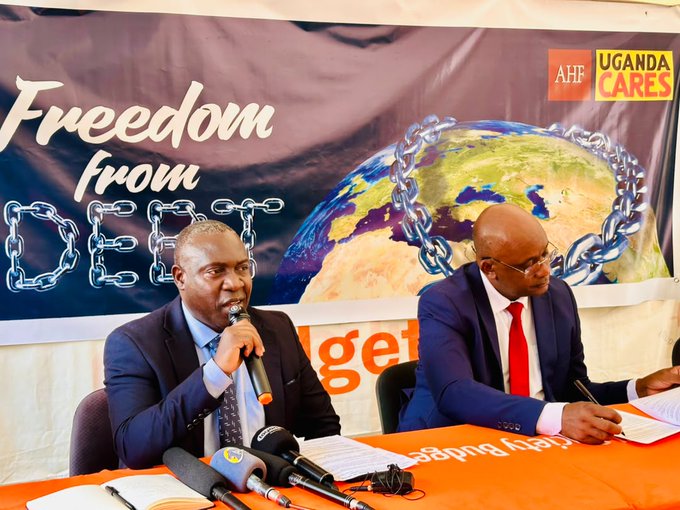
The concerns were raised during the launch of the Freedom from Debt Campaign by AIDS Healthcare Foundation (AHF) Uganda Cares in partnership with the Civil Society Budget Advocacy Group (CSBAG) at Ntinda in Kampala.
The campaign, part of a wider African movement on debt justice, seeks to promote transparency, accountability, responsible borrowing and sustainable development financing.
According to figures presented during the press conference, Uganda’s public debt is projected to rise to about Shs130 trillion by the 2026/2027 financial year, up from approximately Shs94.9 trillion in FY2023/24 and Shs86.8 trillion in FY2022/23.
Officials warned that debt servicing obligations are expected to exceed Shs33.6 trillion, including about Shs14.1 trillion in interest payments and Shs4.18 trillion in loan amortisation.
The organisations said debt repayments are projected to consume nearly 40 percent of Uganda’s domestic revenue collections, reducing the fiscal space available for critical public services and development programs.
“For every Shs100 collected from taxpayers, over Shs41 goes toward debt repayment before a single shilling reaches a health facility, classroom or community project,” officials noted.
Henry Magala, Country Program Director at AHF Uganda Cares, described debt as both an economic and human rights issue.
“When countries spend more on debt servicing than on health and education, essential services suffer and millions of people are left behind,” Magala said.
The campaign cited global statistics showing that public debt worldwide reached a record US$102 trillion in 2024, nearly three times higher than two decades ago.
According to the World Bank and International Monetary Fund, about 54 percent of low-income countries are either already in debt distress or at high risk of debt distress.
In Africa, external debt has reportedly exceeded US$650 billion, with the continent spending nearly US$90 billion annually on debt servicing.
Organisers noted that more than 25 African countries now spend more on debt repayments than on healthcare.
CSBAG Executive Director Julius Mukunda said Uganda’s challenge is not simply borrowing, but poor planning, inefficiency and weak management of debt-financed projects.
“Debt should finance roads, hospitals, schools, irrigation systems and productive investments that transform livelihoods, not inefficiencies and avoidable delays,” Mukunda said.
According to findings shared during the conference, Uganda continues to pay huge commitment fees on external loans that remain unused due to delayed implementation.
The Auditor General’s report for FY2023/24 reportedly showed that Uganda paid about Shs73.9 billion in commitment fees on undisbursed loans.
Hildah Tumuhe revealed that only 66 percent of projects included in Uganda’s Public Investment Plan had undergone feasibility studies.
“Poor project preparation contributes to costly delays, budget overruns and rising public debt,” she said.
The organisations also highlighted the direct impact of debt pressures on public services.
According to the Auditor General’s findings cited at the event, Mulago National Referral Hospital received only Shs18.25 billion against a requirement of Shs72.4 billion for specialised medicines and supplies, leaving a funding gap of nearly 75 percent.
In the education sector, 136 secondary schools reportedly lacked science laboratories, 182 schools had no libraries and 380 schools faced classroom shortages.
The campaign further criticized limited citizen participation in debt governance, noting that many Ugandans have little access to loan agreements and borrowing information despite carrying the burden of repayment through taxes.
CSBAG and AHF Uganda Cares called for stronger parliamentary oversight, greater transparency in debt management and reforms in the global financial system to ensure debt supports development rather than undermining it.
Among the proposals raised were automatic debt-service pauses during public health emergencies or climate disasters, fair debt restructuring mechanisms and increased affordable financing for developing countries.
The organisations also backed the establishment of a Borrowers’ Forum to strengthen Africa’s collective bargaining power on global debt issues.
“Debt must finance hospitals before interest payments, classrooms before commitment fees and jobs before debt dependency,” the campaign stated.
Organisers urged governments, lenders, development partners and citizens to work together in ensuring responsible borrowing and sustainable development financing.