
 Mama FM
30 October 2026, 12:12 pm
By Byamukama Alozious
African countries are spending far more on repaying debt than on tackling the climate crisis, raising concerns that limited public financing could undermine efforts to protect food production, support vulnerable communities and build resilience against extreme weather.
An analysis presented by ActionAid International shows that climate-vulnerable countries are spending nearly 25 times as much on debt repayments as on climate action in 2026, highlighting the financial pressures facing governments already struggling to respond to droughts, floods and other climate-related shocks.
The findings were presented during a Global South Media Science Café organised by the Media for Environment, Science, Health and Agriculture (MESHA), in partnership with ActionAid International, on October 29, 2026. The online engagement examined the relationship between debt and climate change, financing for sustainable agriculture and issues expected to shape the United Nations climate negotiations at COP31.
Teresa Anderson, ActionAid International’s Climate Justice Lead, argued that debt is not merely an economic challenge but also a barrier to climate action, as governments under pressure to meet repayment obligations have fewer resources available for adaptation, public services and the transition to cleaner energy.
According to figures in ActionAid’s presentation, 93.5 per cent of the most climate-vulnerable countries are either in debt distress or at risk of it. The analysis also indicates that these countries spend an average of 65 per cent of their national revenues servicing debt, leaving only about one-third for public services, development and climate-related priorities.
The presentation further reported that the Global South pays 225 times more in debt repayments than it receives in grant-based climate finance.
The figures draw attention to a financing imbalance at the centre of international climate negotiations: countries facing serious climate risks need resources to protect communities and economies, but debt repayments can limit their ability to fund those measures.
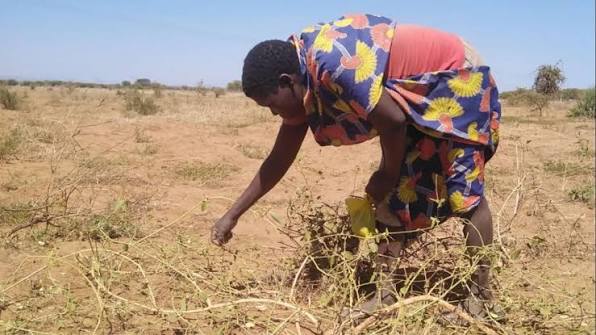
The consequences are particularly significant for agriculture, which supports livelihoods across much of Africa and remains exposed to changing rainfall patterns, droughts, floods and declining soil health.
ActionAid’s presentation cited Zambia as an example of the pressure on public finances. It reported that the country was spending more than 60 per cent of its government budget and 70 per cent of its revenue on debt repayment, while allocating only 0.32 per cent of total government expenditure to climate activities. The presentation linked the country’s financial constraints to difficulties investing in preparedness and adaptation following droughts in 2024 and 2025.
In Malawi, the presentation said debt repayments were expected to consume 70 per cent of the national annual budget in 2026, while the country continued to face the financial consequences of destructive cyclones.
These examples illustrate the wider challenge confronting climate-vulnerable countries: responding to climate disasters requires substantial resources, yet governments may have limited fiscal space to invest in prevention and recovery.
Anderson said debt cancellation could help release resources for climate action, arguing that climate finance commitments must be assessed by the money actually delivered, rather than announcements alone.
The debate also raises questions about the form climate finance takes. ActionAid’s presentation said two-thirds of finance labelled as climate finance by Global North countries had been provided as loans rather than grants. It warned that additional borrowing could deepen debt distress in countries already struggling to meet their climate and development needs.
For African governments, the issue is not simply how much climate finance is promised, but whether it arrives in forms that allow countries to invest in adaptation without adding unsustainable debt.
Agroecology offers an alternative for food systems
The discussion also examined how African countries can strengthen food security and climate resilience through agroecology, an approach that combines ecological farming practices with the sustainable management of soil, water, biodiversity and agricultural resources.
Bavon Christopher, ActionAid Tanzania’s Country Director, presented findings from ActionAid International’s multi-country research examining the economic case for agroecology across 10 African countries: Uganda, Kenya, Tanzania, Ethiopia, Zambia, Zimbabwe, Nigeria, Ghana, The Gambia and Malawi.
The research challenges the assumption that sustainable farming necessarily means lower productivity. Its findings suggest that agroecological practices can deliver competitive yields while reducing dependence on costly external inputs and improving soil health.
In Nigeria, the presentation reported that agroecological farming recorded maize yields of 3.6 tonnes per hectare, compared with 2.9 tonnes under conventional farming, representing an increase of about 24 per cent. Cassava yields were reported at 18 tonnes per hectare, compared with 14 tonnes under conventional farming, while vegetable yields reached 7.3 tonnes per hectare against 5.2 tonnes.
The same presentation reported higher soil organic matter and nitrogen levels under agroecological systems in the Nigerian comparison, indicators associated with soil fertility and productive capacity.
In Kenya, the research cited a 37.8 per cent increase in broad household productivity per hectare under agroecological practices, attributed to input-cost savings and crop diversification. It also cited multi-year trial data showing 53 per cent higher long-term profitability in organic systems where premium markets rewarded produce with price premiums of 25 to 50 per cent.
However, the presentation acknowledged that results vary by crop, location and farming practice, and that the transition may require time, training and initial financial support.
The evidence therefore points to the importance of evaluating not only how much food farms produce, but also farmers’ production costs, household incomes, soil health and ability to withstand climate shocks.
Agroecological practices such as intercropping, crop rotation, agroforestry, composting and the use of locally adapted seed varieties can help diversify production and reduce farmers’ dependence on expensive synthetic fertilisers and pesticides. Healthier soils can also improve moisture retention, helping crops withstand periods of irregular rainfall.
For smallholder farmers, the transition is not without challenges. It may require additional labour, access to reliable technical advice, suitable markets and investment in equipment, storage and processing facilities.
ActionAid’s presentation identified inadequate public agricultural allocations, weak research and extension services, transition risks and fragmented coordination between agriculture, climate and finance institutions as barriers to scaling up agroecology.
The organisation called for increased investment in farmer training, research, local bio-input production, labour-saving technologies and market infrastructure. It also urged governments to make agroecology an explicit national budget priority and to examine whether agricultural subsidies adequately support sustainable farming.
The financing question is particularly important for women and young people, who play significant roles in agricultural production and food systems but may struggle to access capital, land, technology and markets.
Christopher’s presentation argued that investment should extend beyond production to the wider food system, including seed diversity, aggregation, storage, processing, local procurement and routes to market. Such investment could create opportunities for businesses producing compost and biological pest-control products, as well as for young people working in digital agricultural advice, renewable-energy-powered processing and extension services.
COP31 faces a test on climate finance
The debt and agriculture discussions come ahead of the 31st Conference of the Parties to the United Nations Framework Convention on Climate Change, known as COP31, scheduled for November 9–21, 2026, in Antalya, Türkiye.
Anderson’s presentation identified adaptation finance, agriculture, energy transitions, gender, just transition and debt as key issues to watch during the negotiations.
A major question for African countries will be whether wealthy nations provide sufficient, predictable grant-based financing to help vulnerable countries prepare for climate impacts and implement their climate commitments.
The presentation said the Africa Group of Negotiators was pushing for greater clarity on the commitment to triple adaptation finance agreed at COP30. It called for a clear baseline, a delivery plan and greater emphasis on grants, while noting that even the proposed level would not fully meet the scale of need.
Agriculture is also expected to feature prominently, including discussions on how agroecology can contribute to climate adaptation, mitigation, food security and biodiversity conservation.
Another issue is the proposed just transition mechanism, intended to help workers and communities navigate the economic and social changes associated with climate action. ActionAid argues that such a mechanism should protect livelihoods and rights, support skills development and ensure that women, workers, Indigenous peoples and affected communities have a meaningful voice in decisions.
The organisation also warned that climate policies must avoid shifting the costs of the transition onto vulnerable households through job losses, higher living costs or reduced access to affordable food and energy.
For Africa, the outcomes of COP31 will matter not only in terms of new commitments, but also in whether financing reaches local farmers, women-led organisations and communities facing climate risks.