
 Tiger FM
Tiger FM
Tiger FM
1 September 2026, 5:16 pm
By Ronald Ssemagonja
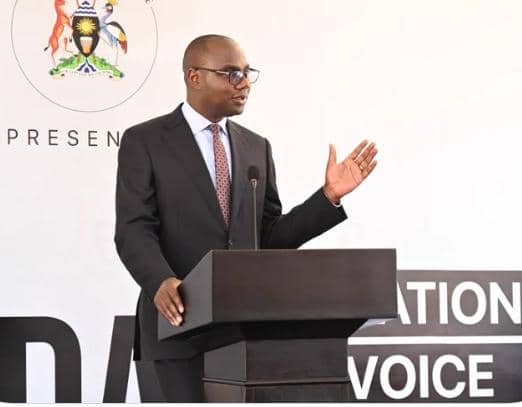
Finance Minister Henry Musasizi has urged Uganda’s capital markets to play a bigger role in mobilising the long-term capital needed to finance the country’s economic transformation towards a US$500 billion economy by 2040.
Musasizi made the remarks today at the Uganda Media Centre in Kampala during the launch of activities to mark the forthcoming celebrations of the Capital Markets Authority.
He said Uganda’s capital markets have developed over the past three decades from a relatively nascent industry into an increasingly important component of the financial system.
According to Musasizi, by August 2026, domestic market capitalisation stood at 24.28 trillion shillings, while the corporate bond market had mobilised about 290 billion shillings. Collective Investment Schemes had also reached about 7.08 trillion shillings in assets under management.
He said these developments demonstrate growing participation in formal investment, increased access by businesses to alternative sources of finance and the growing role of capital markets in mobilising long-term capital.
Musasizi said the Tenfold Growth Strategy, which targets a US$500 billion economy by 2040, will require huge amounts of long-term capital to finance infrastructure, industrialisation, commercial agriculture, tourism, energy, housing, manufacturing, technology, innovation and the expansion of Ugandan enterprises.
“This ambition cannot be achieved through Government expenditure or bank financing alone,” Musasizi said, stressing the need for deeper and more effective capital markets.
The Minister also called on Ugandans to move from a culture of saving to one of investment, supported by greater financial literacy and investor education to enable ordinary citizens to access investment opportunities and protect their savings.
He emphasised that investor protection must remain at the centre of capital-market development through strong disclosure requirements, market surveillance, enforcement, corporate governance and public awareness.
Meanwhile, Capital Markets Authority CEO Josephine Okui Ossiya said the Authority had grown from a small institution into an organisation with a bigger responsibility of connecting Uganda’s savings to investment opportunities.
Ossiya said that in the first year of the Authority’s new five-year strategic plan, 63 percent of the 43 strategic indicators had been achieved or exceeded, while work-plan implementation stood at 99.5 percent.
She said assets under Collective Investment Schemes had reached approximately 7 trillion shillings, while total funds mobilised through capital markets stood at approximately 23.4 trillion shillings.
She added that public understanding of capital markets had reached 60.8 percent, while the number of Collective Investment Scheme investor accounts stood at 241,000.
Ossiya further said domestic capitalisation of the Uganda Securities Exchange had surpassed 15 trillion shillings, adding that the CMA currently regulates more than 160 licensed market participants.
Dr Japheth Katto, the CMA’s first Chief Executive Officer, said one of the Authority’s greatest achievements was proving that a capital market could work in Uganda.
The Capital Markets Authority celebrations are scheduled to take place in October this year.